








Al Dentes’ uses 175 different ingredients (dried, granulated and powdered), along with
liquid and encapsulated oils, to create 80 to 100 custom blends. The company has become
the largest supplier of dried spices, herbs and seasonings in the Las Vegas metro area.
It also provides custom and private-label products in Hawaii and the western United States.
The company can take any existing blend and adjust it to suit a chef’s liking or convert a blend
to purer raw materials. Because of the volume of spices they use, they can also convert raw materials
to ones with better price points, according to Matthew McClure, Al Dentes’ general manager.
Al Dentes’ Provisions decided to purchase a Munson Model HD-2-1/2-5-SS horizontal ribbon
blender with a 25-cu.-ft. capacity. Because properly mixing each spice blend is critical to Al Dentes’ success,
the company wanted equipment that would produce a fully incorporated, homogenous mix.
The Munson blender is now used for all of Al Dentes’ seasoning blends, with three to eight batches
running each day. The ingredients are delivered manually to the blender via totes. Staging and weighing
take approximately 30 minutes; the blending time is generally an hour regardless of the batch size,
says McClure. Once blended, the mix is discharged into a tote via a manually activated paddle gate.
Al Dentes’ bulk densities run from one extreme to the other. Al Dentes has very heavy, granulated
elements like salt, sugar and garlic that it typically runs in 800-pound batches. On the other extreme
is an herb blend like its Italian seasoning, which includes a mixture of light, fluffy dried herbs.
With this mix, a batch of equivalent volume would weigh only 200 pounds. Regardless of the bulk
density or type of material, the blender’s split, double helical agitator with its 2:1 length-to-diameter ratio
promotes the thorough mixing of all the ingredients during loading, blending and discharge.
Powered by a 10hp motor with a shaft-mounted drive, the agitator is flange mounted for easy
access and cleanability.
Tight tolerances of 1/16 to 1/32 in. between the ribbon blades and blender trough minimize the amount of
residual product in the machine after discharge, which is a big advantage to clean-out. All the surfaces that
contact the spice ingredients are constructed of 304 stainless steel, which allows
thorough cleaning between batches. The blending trough is a one-piece welded unit, with no need for cross
trusses to support the side walls. The internal welds are polished from 150 to 240 grit and have a
minimum 1/4-in. radius to eliminate corners, cracks and crevices that could entrap material.
The HD-series blender handles both free-flowing materials and oily or pasty non-free-flowing products.
Heavily powdered blends create some of biggest mixing challenges. Highly pulverized powder can become
sticky with heat, and if you add oil, as Al Dentes does to act as a carrier for flavor, things get tricky.
To address this issue, Al Dentes’ makes a prebatch that combines the liquid oil with a granular ingredient.
The company then adds the granular mix to the powdered ingredients to avoid any clumping and make
sure blends are consistent from batch to batch.
PSS 4000 Automation System Ensures Safety Management
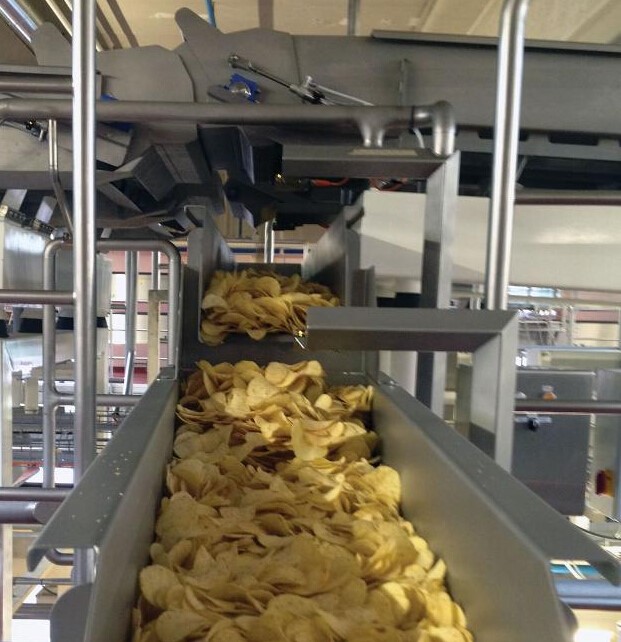
Swiss potato chip manufacturer Zweifel Pomy-Chips sought a reliable partner in
addressing safety requirements. Optimization of individual machine components
can significantly increase the productivity of a whole plant. However, in accordance
with machinery safety regulations and standards, in many cases a risk analysis is
involved, along with the production of a qualified safety concept.
Pilz assisted Zweifel Pomy-Chips as this well known Swiss potato chip manufacturer
went through a modernization process. The PSS 4000 automation system implemented
at the snack manufacturer’s Spreitenbach facility ensures efficient and transparent
safety management. The production plant is spread over two floors and uses five tons
of potatoes an hour to make chips in a variety of flavors. With almost 400 employees,
the company manufactures chips as well as numerous other snacks and nibbles.
Zweifel has always placed the greatest importance on innovative production processes,
which guarantees a consistently high-quality product.
The Zweifel project involved modernizing nine packaging lines. The interconnection
between the individual plant sections meant that the interfaces and logic connections
of the E-STOP functions had to be assessed and transferred into one overall case of compliance.
This is where machinery safety regulations and standards come into play.
Machinery must be constructed in such a way that man and the environment are
sufficiently protected from harm. Manufacturers of machinery must give, in the form
of a declaration of conformity, binding confirmation that their plant meets the minimum
requirements. In view of the large number of safety regulations and standards to be
considered, some degree of expertise is required in order to be on the safe side—literally.
Pilz worked in close cooperation with the company to produce a safety-related control concept,
which involved the development of mechanical, electrical,
and other technical engineering solutions for machinery safety. Essential components
in this concept are the application of regulations and standards in accordance with safety
integrity levels (SIL) or performance levels (PL) and the consideration of machine availability
and productivity, including safety aspects. Zweifel was looking for a high-performance safety
control system to link and monitor the exchange of safety-related signals, separately and in
parallel to the plant control system. Essentially the
requirement was that the device had to be highly network-capable, reliable, simple to program,
and easy to use in day-to-day operation.
Conveyors transport the fried chips to the new packaging lines. A pneumatically controlled flap
opens, allowing the chips to reach the fully automated packaging machines. The chips are soon
packaged in the bag and on their way to market, packed in standard transport cartons.
The Pilz configurable control system PNOZmulti had been responsible for the plant’s safety
management. However, as the modernization project made the plant bigger and the
requirements more complex, a more efficient, economical, and modular system was
needed. Thus the implementation of the PSS 4000, a system that also offers the option
tomerge safety and automation.
As the central component in the new packaging operations, the automation system
PSS 4000 for safety and automation monitors all the safety-related functions.
The packaging line includes safety gates as well as an
intelligent access concept. The gates are fitted with magnetic safety switches
PSENmag and the coded safety switches PSENcode from Pilz. The latter are used to
monitor the position of guards in accordance with safety regulations and standards and
also for simple position monitoring.
The pneumatic cylinders are also monitored safely. The flaps must be safely locked
during cleaning; otherwise there is an increased risk of injury.
The E-STOP pushbuttons positioned along the packaging line are also monitored using the
automation system. The company required four autonomous safety circuits. Ultimately
it must be possible to clean one section of the plant without having to bring the whole
plant to a standstill.
The automation system PSS 4000 generally stands for optimum interaction between
hardware and software components, network devices, and the real-time Ethernet. As it is possible to
distribute and transfer control functions consistently
to the periphery, this system enables a wide range of projects to be implemented more
easily and with greater flexibility than with conventional solutions. Rather than having
a centralized control system, a modular user program is made available within a
centralized project. This enables standardized, as well as simple, handling.
With its ability to undertake safety and automation tasks, the automation system
has already proven itself in numerous applications in the widest range of industry sectors.
Communication between the plant control system and the existing Modbus TCP bus system
is running smoothly. Another key factor to choose the automation system was the ability
of the software platform PAS4000 and its graphics Editor to link into the existing structure
of the PNOZmulti Configurator. So parameter setting remains transparent and simple in the future.
Innovative Robot Achieves High Production Through-Rate

It is critical to have high production through-rate to meet the tight deadlines required by supermarkets and retailers. For the fresh produce sector in particular, this raises issues of quality and the need to minimize damage throughout the production process. There can be fairly hefty penalties if damaged produce hits retail shelves and the producers will be held responsible.
Automating a line is the ideal solution but traditionally price has been the biggest hurdle to overcome. However, investing in automation means increased efficiency and reduced overheads – such as agency workers or labor. In recent years robotic systems have become far more affordable than you may realize, for example the cost of FANUC’s latest palletizer the M410iC/185 is 7% lower compared to its predecessor, yet has a 12% increase in payload capacity.
It is important that each product is looked at individually, without applying a broad brush solution to automating a production line. If a punnet of strawberries needs to be moved from A to B and then put into a retail tray, fast movement can cause horrendous damage to the product, so by the time they’re in the tray, juice is already coming out.
For picking and placing a punnet of strawberries, a Fanuc LR Mate 200iD 7L would be ideal. The six-axis robot has a reach of up to 911mm and, because it’s only about the size of a human arm, it minimizes space requirements. Its diversity enables it to handle a broad range of unwrapped goods such as single root vegetables which need to be topped and tailed. The next level up, the LR Mate 200iD 7L, is a six-axis robot with a reach of 91mm. A successor to Fanuc’s LR-Mate200iC, a new slim arm design was engineered to minimize interference to peripheral devices and it can therefore operate in much narrower spaces than traditional robots. In pick and place applications, it is 35% faster than its predecessor and has been specified to work with a diverse range of produce, in this instance root vegetables.
For picking up polybags of onions or potatoes and placing them into retail trays or trolleys, Fanuc’s M20 high performance industrial robot is small but mighty, providing 35kg payload with the highest wrist movements and inertia in its class. This larger work envelope, allows for two lines to be simultaneously serviced. Produce can go in one direction into a cardboard box and the other direction into a retail tray. Efficiency isn’t merely a question of speed, it’s about selecting the right robot to suit a specific project.
Robots have never been so economical and by removing the possibility of human error, the risk of damaged produce is minimized. For the fresh produce sector, this is vital when supplying goods on ever tightening deadlines.
Thermal Imaging Cameras in Food Processing
In the food industry, it’s essential to carefully control the temperature of perishable goods throughout production, transportation, storage and sales. Repeated warnings about illnesses due to tainted and improperly cooked foods highlight the need for tighter process control. Because this almost always involves a human factor, food processors need tools that automate crucial operations in a way that helps minimize human error while keeping costs down.
Thermal imaging cameras are such a tool. Using thermal imaging cameras, processors can make automated non-contact temperature measurements in many food processing applications. Video outputs and digital temperature data can be viewed on various monitors and computers via the Ethernet. How does the thermal imaging camera work? The main elements for non-contact temperature measurements in the food processing industry are a thermal imaging camera and associated software. They act as ‘smart’ non-contact sensors to perform 100% inspections, measuring the temperature of equipment, refrigerated products and cooked foods as they exit the cooking process. Thermal imaging cameras are easy to use and small, and can be positioned almost anywhere as needed. They can also be used to inspect package sealing and improve efficiency in other food processing operations. Thermal imaging cameras have firmware and communication interfaces that enable their use in automated process control. Third-party software makes it easy to incorporate these tools into automated machine vision systems without the need for extensive custom-written control code.
The use of thermal imaging cameras in food processing is growing for applications such as: oven-baked goods, microwave-cooked meats, microwave drying of parboiled rice and other grains, inspecting ovens for proper temperature, proper filling of frozen meal package compartments, checking integrity of cellophane seals over microwave meals, inspecting box flap glue of overwrap cartons, monitoring refrigerator and freezer compartments. Thermal imaging is first and foremost a quality assurance (QA) tool. Controlling the quality and safety of cooked meat products is an excellent use of this technology. A permanently mounted thermal imaging camera can record the temperature of, for example, chicken tenders as they exit a continuous conveyor oven. The objective is to make sure the chicken is cooked enough but not overcooked and dried out. Reduced moisture content also represents yield loss on a weight basis. Thermal imaging cameras can also be used for inspection on microwave precooking lines. Besides improving product quality and safety, overall throughput can be increased. An additional benefit is reduced energy costs.
In addition to cooked food inspections, thermal imaging cameras can monitor conveyor ovens. They can even be part of a feedback loop to help control oven temperature. Another use of thermal imaging cameras for conveyor ovens is monitoring temperature uniformity across the width of the conveyor oven cooking belt. If a heating element inside an electric oven fails, or if there is uneven heating across an air impingement oven, one side of the product stream may be cooler. This can be quickly discovered with thermal imaging cameras. Quality inspections of this sort are much more difficult with conventional contact-type temperature sensors. Thus, thermal imaging cameras can help correct variability and improve quality before the need to scrap a lot of product. Software is available that allows thermal imaging cameras to locate objects and patterns in the images. One application for pattern matching is in the production of frozen meals. Thermal machine vision can use pattern recognition software to check for proper filling of food tray compartments.
A related application is automated 100% inspection of the heat-sealed cellophane cover over finished microwave meals. A thermal imaging camera can see heat radiating from the lip of the container where the cellophane heat-seal is formed. The temperature along the entire perimeter of the package can be checked by using the thermal image with machine vision software. This type of program matches the geometric pattern in the image and its temperatures against the temperatures in a pattern stored in a computer memory. An added function in such a system could be laser marking of a poorly sealed package so it can be removed at the inspection station. An issue affecting product safety indirectly is the integrity of cartons that overwrap and protect food containers. One of the most cost-effective ways of sealing overwrap cartons is to use heated glue spots on the carton flaps. In the past, the integrity of the spot glueing was determined by periodically doing destructive testing on several samples. This was time-consuming and costly. Because the glue is heated, a thermal imaging camera can ‘see’ through the cardboard to check the pattern and size of the applied glue spots. The camera can be set up to look at predefined areas of the flaps where glue should be applied and verify spot sizes and their temperatures.
The digital data collected is used for a pass/fail decision on each box, so bad boxes can be immediately removed from the production line. The data is automatically logged into the QA system for trend analysis, so a warning can be generated if an excessive number of boxes begin to fail. Yet another application for thermal imaging cameras is monitoring container filling operations. Although this is seldom a product safety issue, it does affect yield and compliance with regulations. Different areas on the bottle can be defined and used to trigger an alarm and remove bottles that are under- or overfilled. Thermal imaging cameras are a better alternative to visible light cameras when a bottle or jar is made of opaque or dark-colored glass or plastic.
Application software currently available for thermal imaging cameras includes a wide variety of functions that support automated food processing applications. This software complements and works in conjunction with firmware built into thermal imaging cameras. The imaging tools and libraries in these packages are hardware- and language-independent, making it easy for food processing engineers to quickly implement thermal monitoring and control systems. Thermal imaging cameras themselves provide the user with different operating modes that support correct temperature measurements under various conditions. Two functions commonly found in these cameras are a spotmeter and area measurements. The spotmeter finds the temperature at a particular point. The area function isolates a selected area of an object or scene and usually provides the maximum, minimum and average temperatures inside that area. The temperature measurement range typically is selectable by the user. As an adjunct to the temperature range selection, most cameras allow a user to set up a color scale or grey scale to optimize the camera image.
In conveyor oven applications, the area function is typically used because pieces of cooked product are often randomly located on the conveyor. The camera can be programmed to find and measure the minimum and maximum temperatures within the defined area. If one of those setpoint temperatures were to fall outside the user-defined limits, an application program running on a PC or PLC would instantly trigger an alarm, alerting the operator to check the thermal image on a video monitor or PC to find and remove the bad product and/or adjust the cooking temperature. In the case of local monitoring, an IR camera’s digital I/O can be used to directly trigger an alarm device without additional software. However, food processing often benefits from higher level analytics that are available in third-party software that runs on a PC. These out-of-the-box solutions do not require the writing of application source code. By adhering to commonly used machine vision interface standards, such as GigE Vision, a wide range of functionality is supported. A simplified block diagram of conveyor monitoring is shown.
One thermal imaging camera is adequate for many applications, or a thermal imaging camera may be combined with a visible light camera to record other target object attributes, such as color.